





Contents
- 1 - Storage-first bedroom planning: start with function
- 2 - Built-in storage vs furniture-based solutions
- 3 - What is an ottoman bed?
- 4 - Why ottoman beds work so well in modern homes
- 5 - When an ottoman bed may not be ideal
- 6 - Ottoman beds vs wooden bed frames: a practical comparison
- 7 - Ideal use cases in renovation projects
- 8 - Design tips for using ottoman beds well
- 9 - Final verdict: is an ottoman bed worth it?
- 10 - DIY measuring checklist: is an ottoman bed practical for your room?
- 11 - DIY takeaway
When planning a bedroom renovation or refresh, storage is often the limiting factor. Wardrobes take up wall space, built-in cupboards require structural work, and freestanding drawers can quickly crowd a room. That’s why more homeowners are asking a simple question: is an ottoman bed worth it?
For modern bedroom design, particularly in smaller homes or renovation projects where structural changes aren’t practical, ottoman bed storage can be a smart, space-efficient solution.
But it’s not the right choice for every room. Here’s how to decide.

Storage-first bedroom planning: start with function
Good bedroom design starts with function, not furniture. Before choosing finishes or styling, it helps to list what the room actually needs to store:
- spare bedding and pillows
- seasonal clothing
- suitcases or bulky items
- children’s items, sports gear or hobby equipment
In many homes, especially during renovations, there isn’t the budget or appetite for built-in storage. This is where furniture-led solutions (beds included) become part of the design strategy rather than an afterthought.
Built-in storage vs furniture-based solutions
Built-in storage
Built-in wardrobes and cupboards are effective, but they come with trade-offs:
- require carpentry or structural work for ample wardrobe space
- reduce flexibility if room use changes
- add cost and time to renovation schedules
They work best in long-term layouts where the bedroom function won’t change.
Furniture-based storage
Storage space integrated into furniture offers more functionality and flexibility:
- no building work required
- quicker installation
- easier to change or remove later
Beds with integrated storage sit firmly in this category, and ottoman beds offer the most capacity of all.

What is an ottoman bed?
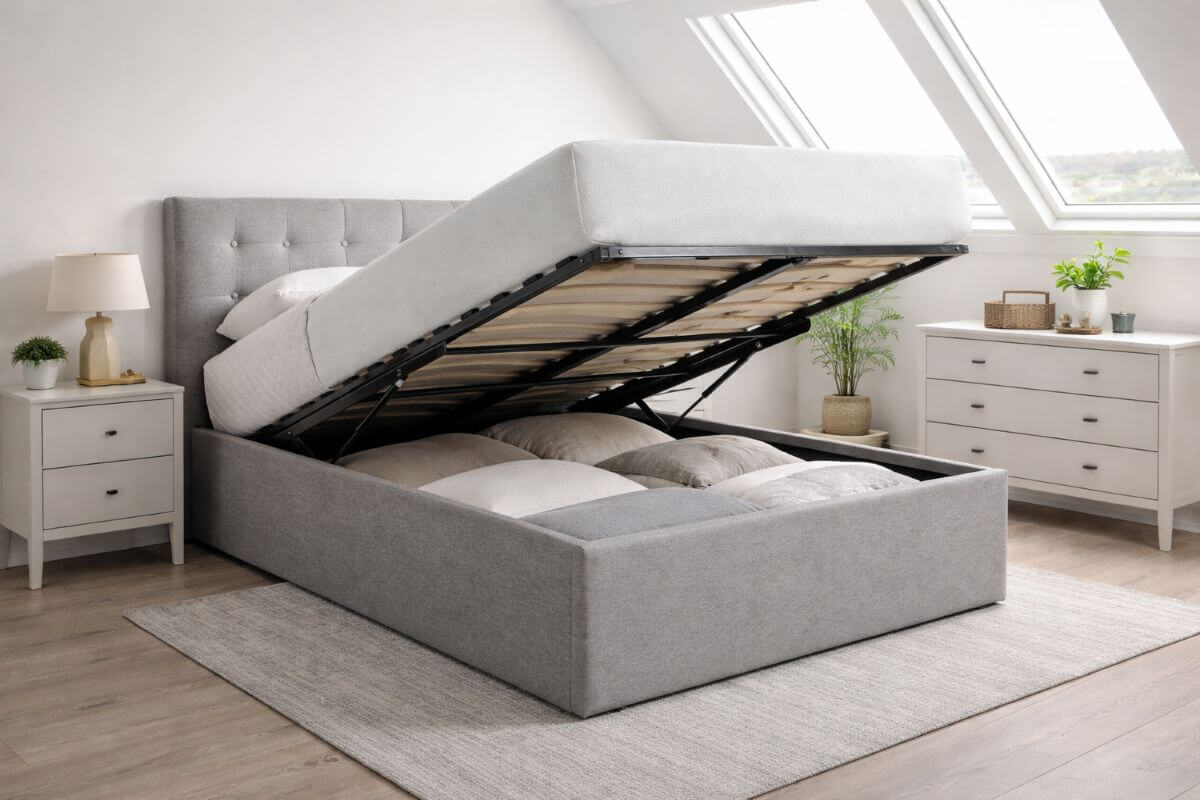
An ottoman bed features a lift-up base (usually gas-lift assisted) that reveals a full storage compartment beneath the mattress. Unlike drawer beds, the entire footprint is usable storage.
This makes ottoman beds particularly appealing in:
- compact bedrooms
- loft conversions
- guest rooms
- rental properties
- renovations where storage is limited
Why ottoman beds work so well in modern homes
1) Maximum storage without extra furniture
Ottoman beds can replace:
- a chest of drawers
- under-bed boxes
- spare cupboard space
This helps keep layouts cleaner and improves circulation around the room.
2) No structural changes required
For renovation projects, this is key. An ottoman storage bed adds significant storage without altering walls, floors or ceilings, making it ideal for budget-conscious upgrades.
3) Cleaner visual lines
Because storage is hidden, rooms tend to look calmer and less cluttered, an advantage in modern and minimalist interiors.
4) They look great
I’m all for beautiful design aesthetics, but practicality and durability are deal–breakers for me. I love Ottoman’s for the convenience as they easily hide the mess that comes with real life. But the upholstery headboards do look very nice.
When an ottoman bed may not be ideal
Ottoman beds aren’t a universal solution. In older UK homes, regular ventilation and breathable bedding matter regardless of bed type. Consider alternatives if:
- you need frequent, daily access to stored items
- the room has limited clearance to lift the mattress easily
- airflow beneath the bed is a priority (e.g. damp-prone rooms)
In these cases, a raised wooden bed frame with under-bed baskets or drawers can be a better fit, offering airflow and flexibility with less lifting.
Also, if you have kids the lifting mechanism is easy to get up, so some education might be needed.
Ottoman beds vs wooden bed frames: a practical comparison
| Consideration | Ottoman Bed | Wooden Bed Frame |
| Storage capacity | Very high | Moderate (with boxes) |
| Structural work needed | None | None |
| Airflow beneath bed | Limited | Good |
| Flexibility over time | Medium | High |
| Visual weight | Clean but solid | Lighter, more open |
The decision often comes down to whether storage or airflow is the bigger priority for your space.
Ideal use cases in renovation projects
Ottoman beds are especially effective in:
- loft conversions, where cupboard height is limited
- box rooms, where freestanding storage would overwhelm the space
- guest rooms, where bedding storage is needed but daily access isn’t
- downsizer homes, where storage must be efficient and hidden
In these scenarios, the bed becomes part of the storage plan rather than just a place to sleep.
Key point: When delivered they need assembly, but this also means they come in parts which means they should fit up your stairs (bed base in two half, head board, and mattress are the big things). Either way, check the dimensions carefully before purchase.
Design tips for using ottoman beds well
To avoid an ottoman bed feeling bulky:
- choose a low-profile frame
- keep headboards slim or upholstered fabrics
- avoid pushing the bed tight against all walls
- plan at least one clear access side for lifting
Pairing an ottoman bed with simple wall-mounted lighting and minimal bedside furniture helps keep the overall design balanced.

Final verdict: is an ottoman bed worth it?
If your priority is maximising storage without building work, then versatility from an ottoman bed is one of the most efficient solutions available. It’s particularly well suited to modern homes, renovation projects and smaller bedrooms where every square metre counts.
However, if airflow, flexibility and frequent access matter more than capacity, a wooden bed frame with modular storage underneath may be the better long-term choice.
The best bedroom furniture designs don’t chase trends, they solve real problems. In many modern homes, an ottoman bed does exactly that.
Tip: A quality mattress is well worth the investment, as waking up refreshed every morning is priceless.
DIY measuring checklist: is an ottoman bed practical for your room?
Before committing to an ottoman bed, spend ten minutes measuring and checking access. It’s a simple step that avoids costly mistakes later.
Tools you’ll need
- Tape measure
- Notebook or phone
- Spirit level (optional, but useful in older properties)
Step 1: Measure the bed footprint
- Measure the length and width of the bed space, including skirting boards.
- Check there’s enough room for at least one clear access side (ideally 60cm where possible).
- There are small double beds (queen size) too, so if you are short on space it could be an option.
Step 2: Check lift clearance
Ottoman beds need vertical and horizontal clearance to open fully.
- Measure from the bed edge to the nearest wall or furniture on the lifting side.
- Ensure the mattress can lift without hitting:
- wardrobes
- windowsills
- radiators
- sloping ceilings (common in loft conversions)
Step 3: Check ceiling height (important in loft rooms)
- Measure ceiling height above the lifting side.
- Sloped ceilings can limit how far the bed can open, especially on end-lift models.
Step 4: Inspect the floor
- Use a spirit level if the floor looks uneven.
- Ottoman mechanisms work best on reasonably level floors; significant slopes can affect smooth lifting.
Step 5: Think about access frequency
Ask yourself:
- Will you access storage daily, weekly, or occasionally?
- Are you happy lifting the mattress regularly, or would drawers be easier?
If access is frequent, consider whether drawers or open under-bed storage might suit your routine better.
Step 6: Plan what you’ll store
Ottoman beds work best for:
- spare bedding, sheets, blankets, pillowcases, duvets and towels
- suitcases and seasonal clothing
- items you don’t need every day
Avoid storing anything you’ll need to grab quickly or frequently. It’s an alternative to storage boxes, not a wardrobe.
DIY takeaway
If the room has enough clearance to lift comfortably and storage access will be occasional rather than constant, an ottoman bed is a highly efficient storage solution, especially in renovations where adding built-in cupboards isn’t practical.


