

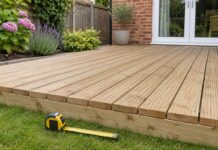








Compare two board directions and up to two stock lengths for a rectangular deck with straight rows and face screws. Measure the usable deck footprint after any perimeter gaps and borders.
How to measure
- Along the boardsMeasure the run each row must span. Stock length and end gaps determine how many pieces each row needs.
- Across the boardsMeasure the width covered by the rows. Use actual board width and the side gap.
- At the joistsConfirm every board end is supported. Count the screw positions at the supports.
- At the supplierCompare both orientations, then round spare boards up to full packs.
Enter your measurements
Use the result to sketch a cutting list
Each piece counts as one stock board. Reusing suitable offcuts may reduce the order. The screw estimate allows support at each end of each piece and intermediate supports at your entered spacing. It assumes the joist layout can accommodate those positions. Count fixings on the actual frame before ordering, especially at butt joints, and use the board maker’s requirements for spacing, minimum piece length, end support and approved fixings. For hidden clips use the manufacturer’s clip schedule. Trex UK installation guide
Worked example
With a 4 × 3 m deck, 145 mm boards and a 5 mm side gap, running along 4 m requires 21 rows. With 4 m stock and no spare allowance that’s 21 boards. In packs of four, buy six packs. At 400 mm planned spacing and two face screws per support, the model estimates 462 screws.
Further Reading


